

Key Takeaways
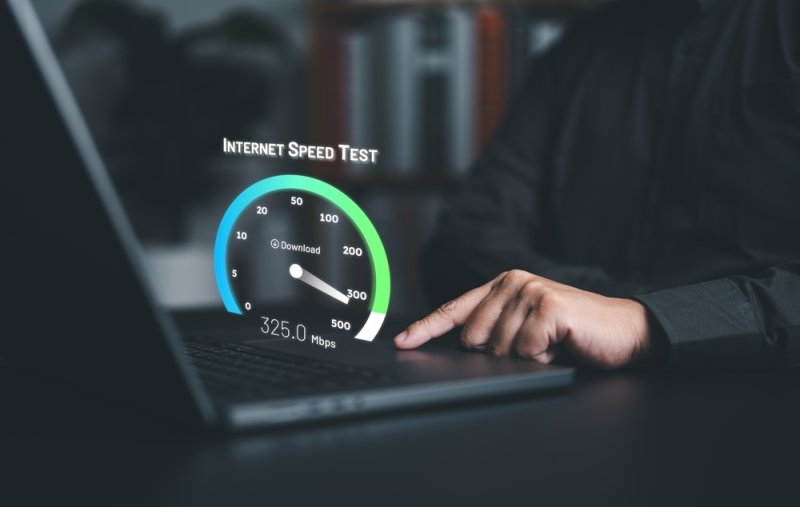
Your internet speed test online measures how fast your internet connection can upload and download data. Quickly test your internet speed online to see your upload and download speeds and ping in seconds.
Fast or slow web page loading or video buffering? You need an internet speed check.
An internet speed test checks the speed of the data flowing back and forth between your device and a testing server and shows you the data in the form of connection speeds. Slow internet speeds are shown in Mbps, while fast ones will be shown in Gbps.
An upload speed test measures the rate at which data leaves your device to the internet. Most internet speed tests also have the capability of measuring the times (ping and jitter), which can give you a more complete picture of your connection's responsiveness and stability.
How does download speed work? Download speed is what causes data to arrive at your computer and impacts your web browsing, Netflix and video watching, or gamers downloading games, files, or using cloud services.
How much bandwidth do I require?
The more people and devices on the connection, the higher the bandwidth required. The more people gaming, streaming, and working online simultaneously, the greater the bandwidth required than an average person who spends most of his or her time browsing.
When you send data over the internet, that's when upload speed comes into play. Video conferencing, uploading photos, working in the cloud, livestreaming, and uploading big files all require upload speed.
The upload speed of a connection could be markedly lower even if the download speeds are good. That might not matter for most browsing but can be detected in video meetings or large uploads.
Ping: The response time between your device and the server. The lower the ping, the faster the response, which is essential in gaming and when video calling.
What is jitter? Jitter measures variations in latency. Jitter may affect applications such as gaming, calls, and others.
Where you are can make a difference. Streaming, downloading, auto-updates, and other devices connected to your internet connection may be using up bandwidth while you're testing.
Before you begin, close down any other apps you aren't using and delay big downloads if you can. If your device allows, connect to your router with a cable via Ethernet. Perform multiple tests and compare the results.
For a WiFi speed test, take tests from various locations. Try a scan close to your router and within the same room as the laptop or PC; compare that to a test from a room where you often have slow speeds.
How do I check internet speed on my PC or smartphone? Troubleshooting is straightforward when you know how to check internet speed on your PC or smart device. Services that allow you to check internet speed online don't require additional software.
To see how to check internet speed on my phone, first of all, connect your phone to your standard WiFi network. Head over to a trusted speed testing site and run the test. Don't change WiFi networks or switch to mobile data in the middle of a test.
To learn how to check internet speed on my computer, connect to the network and perform an online test. Conduct one over WiFi and one through Ethernet if you're able. The two results will tell you if you're being held back by your wireless network.
Testing WiFi speed requires testing your wireless connection at various locations to see how it performs. Distance, walls, interference, connected devices, and the router can all impact your WiFi.
Is your speed comparable near the router and out at a distance? Moving the router to improve the location or coverage of your WiFi might increase your speed.
A broadband speed test allows you to compare the quality of your actual connection with the service you're provided. If you want to know, “How accurate are internet speed tests?" Ethernet testing provides the most accurate results, as it eliminates most of the factors that can affect a wireless connection.
When your wired speed is near what you expect, but WiFi is way slower, broadband could not be the issue.
You will need to decide on the speed you need. It varies depending on the number of people who are using the internet, the number of devices in use, and what activities they're engaging in simultaneously.
You don't require much bandwidth to browse the internet comfortably, but you do if you want to stream video, game online, have a video call, or download anything large. The more devices it has to support, the higher the capacity has to be.
A faster connection isn't necessarily better. Stability, latency, WiFi security, and device compatibility can all be factors.
If you're wondering, "How come my internet speed is so slow?" The process to test the speed: First, run the speed test through WiFi. The WiFi signal will weaken over time due to the walls, various electronics, network congestion, or the router.
Furthermore, the network hardware of your device or PC may limit the speed if it is not able to support such higher internet speeds. Speed is also going to be affected, as there is going to be network congestion on the server hosting the test results.
If the speed test shows you do not have as much bandwidth available as you thought you should (such as 0.5Mbps instead of 50Mbps), reboot your modem and router and run the test. Stop streaming, downloading, backing up, etc. during the tests.
Next, compare WiFi and Ethernet speed. A significant difference could be due to router location, interference, or WiFi coverage. Are both speeds consistently slow? Talk to your internet service provider and verify your plan.
Interpreting your internet speed test results: Knowing what your Internet speed test numbers tell you. Download speed is the rate at which you receive data. Upload speed is how fast you send data. Ping is your lag (or responsiveness), and Jitter is the variation in ping.
Take into account what you actually do online when weighing good internet download and upload speeds. An internet user streaming, working remotely, gaming, and uploading files will need more than a person who does minimal browsing.
How do I tell if my internet is fast enough? A simple online speed test can reveal if you're getting the speed you need for daily tasks. Conduct a speed test and a WiFi test for WiFi speed, and compare your speed test results with both wired and wireless connections. Perform multiple tests at different times of day.
No, you don't have to. Run the speed test when you experience unexpectedly slow performance, switch plans or upgrade your equipment, or are troubleshooting ongoing issues. Multiple tests are more informative than a single test.
Yes. Smart devices all eat up bandwidth. Turn off streaming, downloads, backups, and other data-hungry processes before taking the test to get a more accurate picture of your available speed.
No. An upgraded broadband plan will not fix poor WiFi coverage, interference issues, an old router, or device problems. If you have good wired speed but poor wireless performance, it might be better to fix your WiFi rather than upgrade your plan.
Both are helpful for different reasons. Ethernet generally produces a more accurate result for the connection reaching your device, and WiFi reveals what you encounter wirelessly. Checking both will let you know if WiFi is to blame for the slowdown.
It depends on what you do. Email and general web surfing use not much bandwidth, but video meetings, cloud applications, and large files, and uploads and downloads all the time require a better and more reliable link. It can be useful to test both speeds for a remote working situation.
This content was created by AI